

TL;DR:
- Moldova’s IT exports surpassed 600 million dollars in 2025, accounting for over a quarter of service exports.
- The country offers a low-tax, remote registration system designed specifically for export-oriented IT and SaaS firms.
- Its advantages include full foreign ownership, a 7% turnover tax through the IT Park, simplified reporting, and no physical office requirement.
Moldova’s IT sector quietly crossed a landmark in 2025, with IT exports exceeding $600M and accounting for more than a quarter of total services exports, up 23% year on year. That figure surprises most people who still picture Moldova as a peripheral European economy. What is driving this surge is not luck. International entrepreneurs and IT firms are discovering that Moldova’s cross-border company structure offers a rare combination of low taxes, fast remote registration, and genuine digital infrastructure. This article breaks down exactly what those benefits are, how they compare to rival jurisdictions, and what risks you should weigh before committing.
Table of Contents
- Understanding the basics: What is a cross-border company?
- Unique advantages of cross-border companies in Moldova
- Comparing Moldova with other popular cross-border company destinations
- Key risks and future outlook for cross-border businesses in Moldova
- Our experience: What most guides miss about cross-border benefits in Moldova
- Ready to unlock Moldova’s company benefits?
- Frequently asked questions
Key Takeaways
| Point | Details |
|---|---|
| Low-barrier company setup | Foreign entrepreneurs can register quickly, remotely, and with almost no minimum capital. |
| Powerful tax advantages | Moldova’s MITP offers a single, simple tax regime ideal for export-focused IT firms. |
| Global talent and digital support | Features like the IT Visa and digital registration enable hiring and scaling international teams efficiently. |
| Know the risks | Political and VAT-related risks remain, so ongoing monitoring is crucial for long-term planning. |
Understanding the basics: What is a cross-border company?
A cross-border company is a legal entity registered in one country but operating commercially across multiple markets. The owners, clients, staff, and revenue streams may all sit in different countries. For IT firms and SaaS businesses, this structure is not unusual; it is often the default. The question is not whether to go cross-border, but where to register.
Entrepreneurs choose cross-border structures for three core reasons. First, tax efficiency: registering in a jurisdiction with a lower or simpler tax regime reduces the overall burden on profits. Second, talent access: a foreign registration can make it easier to hire internationally and offer competitive packages. Third, scalability: a lean legal structure in a business-friendly country lets you grow without excessive administrative drag.
Moldova has become a compelling answer to all three. The country allows 100% foreign ownership with remote registration completed in as little as 3 to 7 days and a minimum share capital of roughly €0.05. That is not a typo. The barrier to entry is deliberately low, which is why founders from the EU, the UK, the US, and Asia are registering Moldovan entities without ever setting foot in the country.
The typical structure works like this:
- Register a Moldovan SRL (limited liability company) remotely via Power of Attorney
- Apply to the Moldova IT Park (MITP) regime post-registration
- Invoice international clients from the Moldovan entity
- Repatriate profits or reinvest them under the 0% reinvested profits rule
- Manage everything digitally, with no requirement for a physical office
Pro Tip: Because the minimum capital requirement is negligible, you can test the Moldovan structure with minimal financial commitment before scaling your operations through it.
For a full walkthrough of the process, the Moldova company registration explained guide covers costs, timelines, and practical steps in plain language.
Unique advantages of cross-border companies in Moldova
Once you understand the basic structure, Moldova’s specific offering starts to look genuinely distinctive. It is not simply a low-tax jurisdiction. It is a jurisdiction that has engineered its regime specifically for export-oriented IT and SaaS businesses.
Here is what sets Moldova apart:
- Full foreign ownership with remote registration. You do not need a local partner, a local director, or a physical presence. The entire process runs through Power of Attorney.
- MITP single tax rate. After registration, companies apply to join the Moldova IT Park. Membership replaces the standard tax system with a single monthly payment covering income tax, social contributions, and other levies. The Moldova’s 7% single tax rate applies to turnover, not profit, which simplifies accounting dramatically.
- Simplified reporting. MITP members submit streamlined reports rather than full corporate accounting packages. This reduces your accountancy costs considerably.
- No physical office required. You can operate entirely remotely, which is ideal for distributed IT teams.
- IT Visa for foreign staff. Moldova offers a dedicated visa pathway for non-resident technical employees, making it practical to bring in international talent when needed.
As the MITP registration process confirms, once you are inside the park, a single monthly tax payment covers your obligations, and simplified reporting replaces the standard accounting burden. There is no requirement for a physical office, and the IT Visa mechanism handles foreign staff.
“Moldova’s IT Park regime is not a workaround. It is a purpose-built system for technology exporters, and it shows in the detail.”
For IT and SaaS companies exporting services to EU or US clients, this combination of digital readiness and export orientation is exactly what the structure was designed for. You can read more about why more IT companies are choosing Moldova as their base for cross-border operations.

Comparing Moldova with other popular cross-border company destinations
Context matters. Moldova’s benefits only make sense when you place them alongside the alternatives that international entrepreneurs typically consider.
| Jurisdiction | Corporate tax | Foreign ownership | Digital registration | Developer salaries vs EU |
|---|---|---|---|---|
| Moldova (MITP) | 7% on turnover | 100% allowed | Yes, fully remote | 40 to 60% lower |
| Estonia (e-Residency) | 20% on distributed profits | 100% allowed | Yes, fully remote | Broadly comparable to EU |
| Cyprus (IP Box) | 2.5% on qualifying IP income | 100% allowed | Partial | Moderate |
| Romania | 1 to 3% micro-entity | 100% allowed | Partial | 30 to 50% lower |
| Ukraine (pre-war) | 5% Diia City | 100% allowed | Partial | 40 to 55% lower |
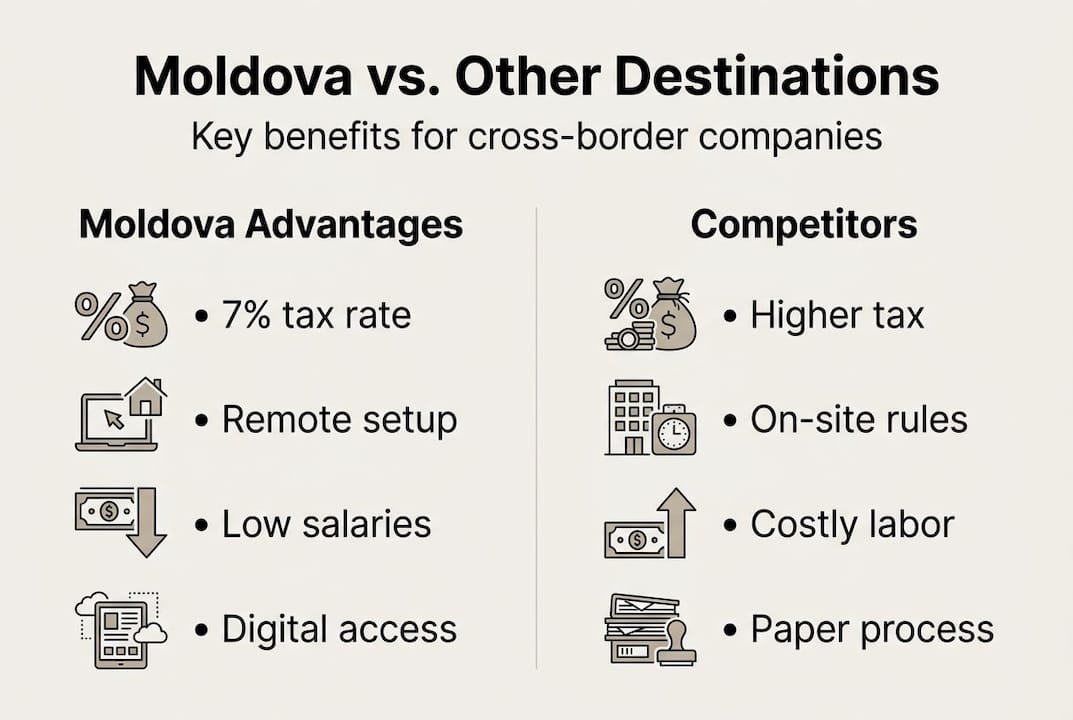
The data tells a clear story. Moldova’s 40 to 60% lower developer salaries versus the EU average, combined with its ranking as the number one digital readiness destination in South-East Europe, make it competitive in ways that go beyond the headline tax rate. Estonia’s e-Residency programme is well known, but its 20% tax on distributed profits is significantly higher. Cyprus’s IP Box rate of 2.5% sounds attractive but applies only to qualifying intellectual property income, not general IT services revenue.
For a broader picture of how Moldova fits into the regional landscape, the Eastern Europe IT tax comparison provides detailed analysis across multiple jurisdictions. And if you want to go deeper on Moldova specifically, the Moldova tax advantages for IT breakdown is worth reviewing before you make any decisions.
Pro Tip: For remote-first IT firms, the combination of low salaries, digital registration, and a single-rate tax system makes Moldova more operationally efficient than jurisdictions with lower headline rates but higher compliance costs.
Key risks and future outlook for cross-border businesses in Moldova
No jurisdiction is without risk, and Moldova is no exception. A balanced assessment matters before you commit your structure.
The headline risks are:
- Political and economic instability. Moldova is a small economy navigating significant geopolitical pressures. Conditions are improving, particularly as EU accession talks progress, but volatility remains a real factor.
- EU VAT obligations. If your clients are EU-based businesses, you may still face EU VAT registration requirements regardless of where your company is registered. Moldova’s domestic regime does not eliminate this.
- Client perception. Some enterprise clients, particularly in Western Europe, may prefer suppliers with an EU-registered entity. This is a commercial consideration, not a legal one, but it is worth factoring in.
- EU harmonisation risk. As Moldova moves towards EU membership, its tax regime may eventually need to align with EU standards.
The regime is guaranteed until 2035, which gives you a meaningful planning horizon. However, it is prudent to model what your structure looks like post-2035, particularly if EU accession accelerates. The advice from those who know the market well is to use the current window strategically rather than assuming it is permanent.
On the positive side, the MITP has already exceeded $1 billion in total turnover, with 88.5% of that revenue coming from exports. That is not a speculative regime; it is a functioning ecosystem with real scale.
For IT and SaaS companies with high margins and predominantly non-EU clients, the risk profile is manageable. For lower-margin operations or businesses that need an EU base for client or regulatory reasons, Moldova’s economic landscape may not be the right fit. As political and VAT-related risks are noted by independent analysts, the regime suits export-driven firms best.
Our experience: What most guides miss about cross-border benefits in Moldova
Most articles about Moldova lead with the 7% tax rate. We understand why; it is a striking number. But in our experience working with international IT founders, the tax rate is rarely the deciding factor. What actually moves the needle is the combination of elements that Moldova offers.
The digital registration process, the MITP’s simplified reporting, and the IT Visa mechanism together create an operational environment that is genuinely low-friction. Founders who have dealt with the bureaucratic weight of registering in Cyprus or navigating Estonia’s banking landscape often find Moldova’s process refreshingly direct.
The other thing most guides miss is the importance of fit. Moldova works brilliantly for export-focused, high-margin IT and SaaS businesses. It is less well-suited for companies that need an EU legal base, handle significant EU consumer VAT, or operate in regulated financial sectors without additional licensing. Reading real company stories from Moldova reveals a consistent pattern: the founders who succeed here knew their market and structure before they registered, not after.
The true edge is not the tax rate. It is the deliberate design of a system built for technology exporters, and knowing whether your business fits that design.
Ready to unlock Moldova’s company benefits?
If this article has clarified the opportunity, the logical next step is to move from understanding to action. Start with the company formation checklist to confirm you have everything in order before you begin. For a deeper walkthrough of the legal and practical process, the detailed Moldova company guide covers every stage from incorporation to MITP registration. Once your company is active, you will also need to open a bank account in Moldova to receive client payments and manage your finances locally. Our team at Incorpore.md supports international founders through each of these steps, remotely and efficiently.
Frequently asked questions
How quickly can a foreign entrepreneur register a company in Moldova?
You can register remotely within 3 to 7 days, with only minimal share capital required and no need to travel to Moldova in person.
What is the main tax benefit for IT companies joining MITP?
IT firms joining MITP benefit from a single 7% tax rate applied to turnover, replacing the standard corporate tax system and significantly simplifying accounting obligations.
Is the current tax regime guaranteed long-term for cross-border companies?
Moldova’s favourable IT tax regime is guaranteed until 2035, though founders should monitor the situation as EU accession negotiations may eventually require harmonisation.
What types of businesses benefit most from Moldova’s cross-border regime?
High-margin, export-oriented IT and SaaS companies see the greatest advantages, particularly those serving non-EU clients with no requirement for an EU-registered legal entity.
Are there risks for international companies forming in Moldova?
There are some political and VAT-related risks, but conditions are improving steadily and most risks are manageable for export-driven IT businesses with the right structure in place.