

TL;DR:
- Moldova offers a user-friendly, digital-enabled tax system for expats with clear filing procedures.
- The Moldova IT Park regime provides significant tax savings for qualifying software and IT companies.
- Accurate day tracking and professional advice are crucial to maintain compliance and optimize benefits.
Filing taxes as an expat can feel like navigating a foreign language, even when you speak the local one. Moldova surprises most international entrepreneurs with how structured and accessible its tax system actually is. The country’s State Tax Service (SFS) offers electronic filing, pre-filled declarations, and a purpose-built regime for IT companies that rivals anything in Eastern Europe. Whether you are a digital nomad testing residency thresholds, a software founder weighing the Moldova IT Park, or an investor with capital gains to declare, this guide walks you through every essential step with none of the unnecessary complexity.
Table of Contents
- Who must file taxes in Moldova as an expat?
- Which forms and deadlines matter for expat filings?
- Tax benefits and pitfalls for IT and digital entrepreneurs
- Residency tracking, documentation, and compliance tips
- Why expert help pays off in Moldovan expat tax filing
- Get support for tax compliance and company setup
- Frequently asked questions
Key Takeaways
| Point | Details |
|---|---|
| Expats must check residency | Filing obligations in Moldova depend on your tax residency and specific income triggers. |
| CET18 is core | Most expats file the annual CET18 form, due 30 April, using digital or paper channels. |
| IT Park offers unique benefits | Digital businesses in the IT Park regime can access 7% tax but must meet strict compliance requirements. |
| Residency tracking matters | Accurate records of days spent and compliance documents are essential for avoiding audits and fines. |
| Expert help prevents mistakes | Local advice is invaluable for navigating subtle rules and ensuring full compliance as an expat entrepreneur. |
Who must file taxes in Moldova as an expat?
The first question most expats ask is deceptively simple: do I even need to file? The answer depends on your residency status and the sources of your income, not your passport.
Tax residency in Moldova is established when an individual spends 183 days or more in the country during any 12-month period that falls within a calendar year. However, the threshold is not the only trigger. Moldova’s tax code also considers your “centre of vital interests,” meaning where your permanent home, family, and primary economic activity are based. If Moldova is clearly your principal base of operations, even shorter stays can create tax obligations.
Common filing triggers for international entrepreneurs and IT professionals include:
- Earning income from a Moldovan-registered company, including dividends or director fees
- Receiving capital gains from the sale of Moldovan assets or shares
- Holding a Moldovan SRL (Societate cu Răspundere Limitată, the standard limited liability company) and drawing a salary
- Having worldwide income above 360,000 MDL (Moldovan Lei) in a calendar year
- Claiming a tax credit or refund from the SFS
The core filing instrument for personal income tax is the CET18 declaration form. This is not exclusive to Moldovan citizens. The annual CET18 declaration is required by 30 April for all residents reporting worldwide income, capital gains, high earners exceeding 360,000 MDL, or anyone seeking a refund or tax credit, and it can be submitted electronically via sfs.md, by email, or on paper.
Understanding Moldova corporate residency rules matters here too. Corporate residency is distinct from personal residency. You may trigger personal tax obligations even if your company is foreign-registered, simply by being physically present and directing operations from Moldova.
A practical note: If you hold a digital nomad visa, that immigration status does not automatically exempt you from Moldovan tax obligations. Days spent in Moldova count towards your residency test regardless of the visa category you entered under.
Many expats incorrectly assume that because their employer or clients are overseas, they owe no Moldovan tax. This is a costly misconception. Once you cross the 183-day threshold or establish vital interests here, the SFS considers your worldwide income taxable in Moldova, subject to applicable double tax treaties.
Which forms and deadlines matter for expat filings?
Once you have confirmed you need to file, the process itself is more user-friendly than most expect. Moldova has invested significantly in its digital tax infrastructure, and the SFS portal is genuinely functional for foreign users.
Here is the standard process for completing your annual expat filing:
- Register on the SFS Personal Cabinet at sfs.md. You will need your IDNP (personal identification number issued to residents and holders of certain visas). The Cabinet stores your submission history and allows pre-filled data to auto-populate your CET18.
- Review pre-filled data. The SFS pulls employment records, dividend distributions, and certain income sources directly from employer reports. Check these carefully. Errors here are your responsibility to correct before submission.
- Add any missing income sources. Foreign-source income, freelance earnings, rental income, and capital gains not already on the system must be entered manually. Attach supporting documentation where required.
- Submit electronically. The portal accepts e-signatures. Alternatively, you can email a signed PDF scan to your local SFS office or deliver a paper copy in person.
- Pay any tax due. Moldova’s Mpay platform allows you to settle any balance directly online using a bank card or Moldovan bank account, without queuing at a physical office.
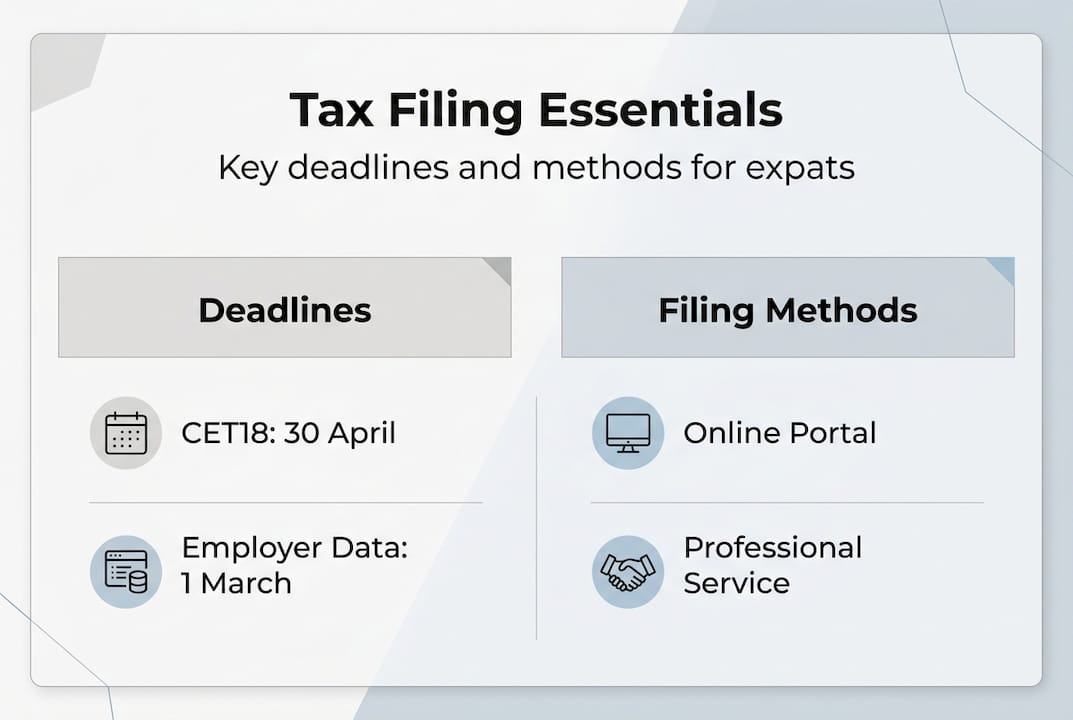
The critical CET18 deadline is 30 April each year for declarations covering the previous tax year. Miss it, and penalties accrue daily. The SFS does not typically grant extensions to individual taxpayers outside exceptional circumstances.
| Filing method | Suitable for | Complexity |
|---|---|---|
| SFS Personal Cabinet (online) | Most expats and residents | Low |
| Email submission (PDF) | Those without IDNP access yet | Medium |
| Paper filing | Complex cases or older filers | Medium to high |
| Through a registered agent | Business owners, IT Park members | Low (for the taxpayer) |
Pro Tip: Set a calendar reminder for 1 March each year. By then, most employer and company data will have been uploaded to your SFS Cabinet, giving you nearly two months to spot errors, gather foreign income documentation, and file comfortably before the April deadline.
Using a professional service for accounting and fiscal rules compliance is strongly advisable if you have income from multiple countries. The pre-fill function is helpful, but it does not account for foreign-source income or treaty-reduced rates. Errors caught during audit are far more expensive than a modest advisory fee paid upfront. If you are running an IT operation, reviewing smart tax filing for IT strategies is worth doing before your first submission.
Tax benefits and pitfalls for IT and digital entrepreneurs
This is where Moldova genuinely differentiates itself from other Eastern European jurisdictions. The MITP (Moldova IT Park) regime is one of the most competitive tax structures available to technology companies anywhere in the region.
Under the MITP regime, qualifying companies pay a single 7% unified tax on their total revenue. This replaces corporate income tax, VAT, social contributions, and most other standard taxes in a single payment. The rate is guaranteed by legislation until 2035, provided the company continues to meet eligibility criteria.
To access this regime, your company must:
- Be registered as an SRL in Moldova
- Earn at least 70% of total revenue from qualifying IT activities (software development, SaaS, IT consulting, and similar)
- Employ at least 5 full-time staff on Moldovan employment contracts
- Submit to an annual independent audit
The contrast with standard Moldovan taxation is significant:
| Tax category | Standard regime | IT Park (MITP) regime |
|---|---|---|
| Corporate income tax | 12% on net profit | Included in 7% unified tax |
| VAT | 20% standard rate | Exempted |
| Social contributions (employer) | ~24% of salary | Included in unified tax |
| Personal income tax (employee) | 12% | Significantly reduced |
| Effective total burden | 35 to 45% | ~7% of revenue |
The savings are substantial. A software company generating 500,000 EUR in annual revenue could save tens of thousands of euros per year compared with operating under a standard European corporate structure. Many IT company tax incentives make Moldova particularly attractive for founders relocating from high-tax jurisdictions.
However, the pitfalls are real. Several common mistakes cost entrepreneurs their MITP status:
- Revenue mix failure. If non-IT revenue creeps above 30% of total income (from consulting, trading, or ancillary services), the company may lose IT Park eligibility for that entire year.
- Staff count shortfall. Dropping below five employees, even temporarily due to resignations or restructuring, can trigger a compliance breach.
- Skipping the annual audit. The audit is not optional. Omitting it, even if accounts are clean, voids the regime for that period.
- Misclassifying IT activity. Not all technology-adjacent work qualifies. Digital marketing, for instance, generally does not count as qualifying IT revenue.
For those setting up an IT firm in Moldova, getting the corporate structure right from day one is essential. The legal entity structuring decisions you make at registration affect your MITP eligibility for years. Foreign founders who structure through the wrong entity type, or fail to register with MITP before beginning operations, often find themselves locked into standard taxation for an entire fiscal year before they can correct course. International tax planning resources on tax incentives for IT professionals confirm that regime selection is almost always the most impactful financial decision for a technology business.

Pro Tip: Apply for MITP registration before your company begins generating revenue. The SFS registers MITP status from the date of application, not from incorporation. Even a two-week delay in applying can mean your first invoices fall under standard taxation rates, creating a mixed-year complication that requires professional reconciliation.
Residency tracking, documentation, and compliance tips
Knowing the rules is one thing. Proving compliance during an audit is another. Moldovan tax authorities have become more diligent in recent years, particularly for high-income individuals and foreign entrepreneurs, and documentation habits you form in your first year will serve you well throughout your time here.
Counting your days accurately is the foundation of personal tax compliance. Here are practical methods:
- Use a dedicated residency tracking app. Apps such as Pebbles allow you to log entry and exit dates with geo-tagged records, creating a timestamped audit trail that is far more credible than memory or rough notes.
- Keep digital scans of all border stamps, airline boarding passes, and hotel receipts. These corroborate your day count if questioned.
- Maintain a simple spreadsheet updated after each trip, noting the country, entry date, and exit date. Cross-reference it against your passport stamps quarterly.
Beyond day tracking, your documentation pack should include:
- Signed copies of all CET18 declarations submitted, with SFS acknowledgement receipts
- Bank statements showing income sources and amounts for each tax year
- Employment contracts, dividend resolutions, or freelance agreements generating your declared income
- Copies of any correspondence with the SFS, including responses to queries or clarifications
- For IT Park companies: annual audit reports, employee contracts, and MITP registration certificates
The SFS electronic filing system makes retrieval easier. Once you file electronically, your submission history is retained in your Personal Cabinet indefinitely, which is helpful if an audit arises several years later.
One nuance that catches many expats off guard is the interplay between tax status and migration status. Your residency permit or visa category affects which SFS registration pathway applies to you, but it does not override the 183-day tax test. Always align your corporate residency compliance strategy with your immigration planning, especially if you are considering acquiring long-term residency or citizenship by investment.
Pro Tip: Request a formal tax residency certificate from the SFS each year. This document, available on application, confirms your Moldovan resident status and is often required by foreign tax authorities to apply treaty exemptions and avoid double taxation on the same income.
Why expert help pays off in Moldovan expat tax filing
Here is an opinion worth stating plainly: digital tools and clear legislation are genuinely useful, but they do not replace professional judgement in edge-case situations.
Many expats approach Moldovan tax filing with quiet confidence after reading the SFS guidelines. They do the day count correctly, they submit the CET18 on time, and they believe they are fully compliant. Then an audit reveals that a foreign dividend was categorised incorrectly, or that their IT Park application had a procedural gap, and suddenly they face penalties and back taxes on income they thought was clean.
The Moldovan tax code is concise compared to Western European equivalents, but its interaction with treaty provisions, MITP regulations, and SRL governance requirements creates complexity that is easy to underestimate. Good fiscal law guidance from a local specialist is not an optional luxury for serious entrepreneurs. It is the difference between a tax structure that delivers the savings you planned for and one that collapses under scrutiny.
Consider professional support not just for annual filing, but as an ongoing strategic relationship. The best outcomes come when advisors are involved at the company formation stage, help you choose the right structure, set up payroll and audit obligations correctly, and then handle annual compliance as a natural extension of that foundation.
Get support for tax compliance and company setup
Ready to simplify your Moldovan compliance? Incorpore works with international entrepreneurs and IT founders at every stage, from initial company structuring to annual tax filings and everything in between. Whether you are working through your first CET18, evaluating the IT Park regime for your software business, or aligning your residency and corporate strategy, our team provides grounded, practical guidance tailored to your situation. Start with our company formation checklist to understand the full setup process, or go straight to our IT company setup guide if you are ready to structure for the 7% unified tax regime. Compliance does not have to be complicated when you have the right team behind you.
Frequently asked questions
Do all expats in Moldova need to file annual tax declarations?
Only those considered tax residents, earning capital gains, high incomes above 360,000 MDL, or seeking tax credits need to file an annual declaration in Moldova. Non-residents with no Moldovan-source income generally have no filing obligation.
When is the Moldovan expat income tax declaration due?
The CET18 form is due by 30 April each year, covering income earned during the previous tax year. Late submission attracts daily penalties under Moldovan tax law.
What is the easiest way to track my residency days for Moldovan tax?
Many expats use residency tracking apps such as Pebbles alongside manual records and scanned travel documents to create a reliable audit trail for Moldovan tax purposes. Keeping a quarterly log significantly reduces the risk of miscounting.
How can an IT business qualify for simplified 7% Moldovan tax?
IT firms must register as an SRL with IT Park, earn at least 70% of revenue from qualifying IT activities, maintain at least five full-time employees, and complete an annual audit. Meeting all four criteria continuously is essential to retaining the unified tax rate through 2035.