

TL;DR:
- Global business formations are at record levels in 2026, driven by AI, remote work, and fintech growth.
- Moldova offers a highly competitive 7% flat tax rate and swift remote company formation for IT and fintech firms.
- The country’s supportive infrastructure and EU association make it an attractive, cost-effective hub for digital entrepreneurs.
Business formation is booming worldwide, and the numbers are striking. Over 1.1 million new businesses were registered in the United States alone in the first two months of 2026, signalling a global entrepreneurial surge that shows no sign of slowing. Yet most international founders still default to the same handful of jurisdictions when planning their company structure, overlooking emerging markets that offer far greater fiscal efficiency. Moldova is one of those overlooked markets, and for IT companies and financial services firms in particular, the opportunity is genuinely exceptional.
Table of Contents
- Global business formation trends in 2026
- Why Moldova stands out for international entrepreneurs
- Navigating regulatory and compliance frameworks in Moldova
- Leveraging AI, fintech, and digital trends for Moldova business success
- What most guides miss about Moldova business formation
- Explore your Moldova business formation options
- Frequently asked questions
Key Takeaways
| Point | Details |
|---|---|
| Record formation rates | 2026 has seen unprecedented business startups, especially in tech and finance globally. |
| Moldova’s unique incentives | Favourable tax, regulatory, and government policies make Moldova appealing for international founders. |
| AI and fintech drive growth | Digital trends and capital flows are reshaping business opportunities in Moldova’s IT sector. |
| Regulatory know-how is vital | Understanding compliance frameworks and legal steps is crucial for successful formation. |
| Practical resources available | Guides and checklists support new businesses launching in Moldova. |
Global business formation trends in 2026
The scale of current startup activity is difficult to overstate. Business formations hit 1.1 million in the US across January and February 2026, representing a 10% year-on-year increase. Florida alone recorded 69,531 new businesses in a single month, February 2026, setting a state record. These figures reflect a broader global pattern: startup rates are at record levels across 53 economies, according to the GEM Global Report 2025 to 2026.
What is driving this surge? Several interconnected forces are at work:
- Artificial intelligence adoption: More than half of small businesses globally are now expanding AI solutions into their core operations, reducing overhead and accelerating product development cycles.
- Remote work infrastructure: The normalisation of distributed teams means founders can register companies in optimal jurisdictions without relocating staff.
- Digital financial services: Fintech platforms have dramatically lowered the cost of cross-border payments and treasury management, making international structures far more accessible.
- Post-pandemic resilience: Entrepreneurs who weathered the disruptions of recent years are now better capitalised and more confident in launching new ventures.
The geographic spread of this activity is also shifting. While the US remains the largest single market for new formations, growth rates in Eastern Europe, South-East Asia, and the Gulf region are outpacing Western markets. International founders are actively seeking jurisdictions that combine low tax burdens with credible regulatory frameworks.
| Region | Formation growth (YoY) | Key driver |
|---|---|---|
| United States | 10% | AI and fintech startups |
| Eastern Europe | 14% | IT outsourcing and digital services |
| Gulf Cooperation Council | 12% | Financial services liberalisation |
| South-East Asia | 11% | E-commerce and platform businesses |
The data points to a clear pattern: founders are no longer simply choosing the nearest or most familiar jurisdiction. They are making deliberate, strategic decisions based on tax efficiency, regulatory clarity, and access to skilled talent. Understanding your tax and compliance strategy from day one is increasingly the difference between a profitable structure and an unnecessarily expensive one.
Why Moldova stands out for international entrepreneurs
Against this backdrop of record global activity, Moldova has quietly become one of the most compelling jurisdictions in Eastern Europe for IT companies and financial services businesses. The country’s appeal is not accidental. It reflects deliberate policy choices designed to attract international capital and talent.

The headline figure is Moldova’s 7% flat corporate tax rate for qualifying IT companies. Compare that to 19% in Romania, 21% in Poland, or 25% in the Netherlands, and the fiscal advantage becomes immediately clear. Beyond the headline rate, Moldova also offers a 0% tax on reinvested profits, meaning companies that channel earnings back into growth pay nothing on those amounts. For a scaling IT firm or a fintech operation, this is a structural advantage that compounds significantly over time.
Tech and IT formations are rising globally as capital concentrates in AI and fintech, and Moldova is positioned to capture a meaningful share of that activity. The government has actively invested in digital infrastructure, broadband connectivity, and technology education, producing a skilled workforce at a fraction of the cost of Western European equivalents.
| Indicator | Moldova | Romania | Poland | Estonia |
|---|---|---|---|---|
| Corporate tax (IT sector) | 7% | 16% | 19% | 20% |
| Tax on reinvested profits | 0% | Standard rate | Standard rate | 0% |
| Company formation time | 3 to 5 days | 5 to 10 days | 7 to 14 days | 3 to 5 days |
| Minimum share capital | Low | Moderate | Moderate | Low |
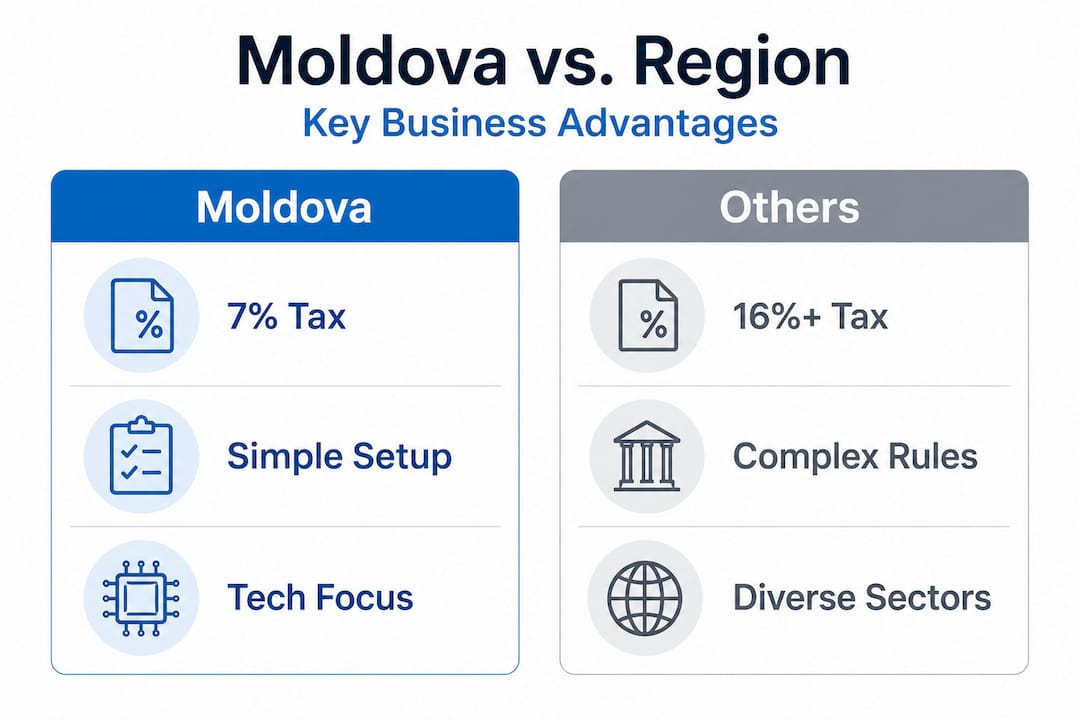
The comparison table above illustrates why Moldova deserves serious consideration alongside Estonia, which has long been the default choice for digital entrepreneurs in Eastern Europe. Moldova’s formation timelines are equally fast, its tax rates are more competitive for IT businesses, and its cost base is substantially lower.
Key advantages for international founders include:
- Remote formation via Power of Attorney: You do not need to travel to Moldova to register your company. The entire process can be completed remotely, which matters enormously for international entrepreneurs managing multiple priorities.
- English-language support: Professional service providers operate in English, removing the language barrier that deters many founders from exploring Eastern European jurisdictions.
- EU association agreement: Moldova’s Association Agreement with the European Union provides preferential market access and regulatory alignment, giving Moldovan-registered companies a credible gateway into EU markets.
- Low operational costs: Office space, local staff, and professional services cost a fraction of Western European equivalents, preserving margins for growth investment.
Pro Tip: If you are structuring an IT or fintech business, review the specific IT firm tax benefits available under Moldovan law before finalising your corporate structure. The qualifying criteria are straightforward, but meeting them from day one avoids costly restructuring later.
The fintech and IT guide covers the sector-specific requirements in detail, including licensing thresholds and capital requirements for financial services operations.
Navigating regulatory and compliance frameworks in Moldova
Understanding Moldova’s advantages is one thing. Successfully navigating the formation process is another. The good news is that the framework is genuinely straightforward compared to many Western European jurisdictions, but there are specific steps you need to follow correctly to avoid delays or compliance gaps.
The standard formation process for a Moldovan limited liability company (SRL, the local equivalent of an LLC) involves the following steps:
- Choose your legal structure: Most international founders opt for an SRL due to its flexibility and limited liability protection. Joint-stock companies (SA) are more appropriate for larger operations requiring external investment or public listings.
- Reserve your company name: This is done through the State Registration Chamber and typically takes one working day.
- Prepare the founding documents: Articles of association, shareholder agreements, and director appointment documents must be prepared in Romanian, the official language, though professional service providers handle translation and notarisation.
- Complete tax registration: Automatic upon state registration, but sector-specific tax regimes (such as the IT preferential rate) require a separate application to the State Tax Service.
- Open a corporate bank account: Moldova’s banking sector is well-developed, and most major banks offer accounts for foreign-owned companies. Account opening typically takes five to ten working days.
- Register for VAT if applicable: Mandatory once annual turnover exceeds the threshold, currently set at 1.2 million Moldovan lei.
The formation checklist provides a step-by-step reference for each stage, including document requirements and typical timelines.
Common mistakes that slow down the process include submitting founding documents with inconsistencies between the articles of association and shareholder agreements, failing to apply for the IT preferential tax regime at the point of registration, and underestimating the due diligence requirements for financial services licences.
“The most expensive compliance mistake is not the one that triggers a fine. It is the structural error made at formation that forces a complete reorganisation twelve months later.”
AI integration is accelerating across more than half of small businesses globally, and this trend is directly relevant to compliance. Founders launching AI-driven products or services in Moldova need to ensure their corporate objects clause is broad enough to cover their actual activities, and that their data processing arrangements comply with Moldova’s alignment with GDPR principles.
For financial services businesses, the compliance bar is higher. Payment institutions, electronic money institutions, and investment firms require licences from the National Bank of Moldova or the National Commission for Financial Markets. The process and tax benefits overview explains how these licensing requirements interact with the tax registration process.
Pro Tip: Engage a local legal adviser to conduct due diligence steps on your proposed structure before submitting any documents. A two-hour consultation at this stage can prevent weeks of delays later.
Leveraging AI, fintech, and digital trends for Moldova business success
The global data is unambiguous. Over 50% of small businesses are expanding AI solutions into their operations, and capital is concentrating heavily in AI and fintech ventures. For founders choosing Moldova as their base, this trend creates a specific set of opportunities that are worth understanding in practical terms.
Moldova’s IT sector has grown substantially over the past decade, supported by a university system that produces strong software engineering and mathematics graduates. The country’s tech community is connected to broader European and global networks, meaning founders can access local talent without sacrificing quality or international perspective.
Practical ways to leverage digital trends within a Moldovan business structure include:
- Build AI tooling into your service delivery from day one: Moldovan labour costs are low enough that you can afford to invest in AI infrastructure while maintaining competitive pricing in European markets.
- Use Moldova as a nearshore development hub: Many international IT companies register their development entity in Moldova to benefit from the 7% tax rate while serving clients across the EU and beyond.
- Structure fintech operations around Moldova’s licensing framework: The National Bank of Moldova has developed clear pathways for payment institution licensing that are less burdensome than equivalent processes in the UK or Germany.
- Leverage EU market access: Moldova’s Association Agreement means that software and digital services developed by Moldovan companies can be sold into EU markets with preferential treatment.
- Integrate cloud-based accounting and compliance tools: Several international platforms support Moldovan tax reporting, making it straightforward to maintain compliance without a large local finance team.
The remote business setup guide is particularly relevant here. Many founders complete the entire formation process, including bank account opening, without visiting Moldova once. The Power of Attorney mechanism allows a local representative to act on your behalf throughout, which is a significant practical advantage for busy international entrepreneurs.
The intersection of Moldova’s low tax environment with the global surge in AI and fintech investment creates a genuine structural opportunity. Founders who move quickly can establish operations before the jurisdiction becomes widely known, capturing the cost and tax advantages before competitive pressure narrows them.
What most guides miss about Moldova business formation
Most articles about business formation in Eastern Europe treat jurisdictions as interchangeable, offering generic advice about tax rates and formation timelines without engaging with the specific texture of each market. Moldova is consistently underrepresented in these guides, and that underrepresentation is itself an opportunity.
The conventional wisdom says: choose Estonia for digital businesses in Eastern Europe. Estonia is excellent, and its e-Residency programme is genuinely innovative. But Estonia’s corporate tax system, while efficient, does not offer the same headline rate advantage for IT companies that Moldova provides. The 7% flat rate is not a promotional figure. It is a structural feature of Moldovan tax law that applies to qualifying IT companies as a matter of course.
What we observe consistently is that founders who investigate Moldova seriously tend to be surprised by two things. First, how straightforward the formation process actually is, particularly when supported by experienced local advisers. Second, how robust the local professional services ecosystem has become. Accountants, lawyers, and corporate service providers in Chisinau are sophisticated, internationally oriented, and accustomed to working with foreign clients.
The power of attorney guidance is a good illustration of this sophistication. The mechanism is well-established in Moldovan law, clearly documented, and routinely used by international founders who complete their entire formation process remotely. This is not a workaround or a grey area. It is a standard, legally recognised process.
The founders who benefit most from Moldova are those who approach the jurisdiction with genuine curiosity rather than preconceptions. They do the work to understand the specific tax regime, the compliance requirements, and the local professional landscape. That investment of time pays back many times over in fiscal efficiency and operational flexibility.
Explore your Moldova business formation options
If the trends and insights covered in this article resonate with your business plans, the logical next step is to understand exactly how a Moldovan structure would work for your specific situation. The Moldova company formation guide provides a thorough overview of the process, from choosing a legal structure through to ongoing compliance obligations. For founders who want to think strategically about how formation decisions interact with long-term tax planning, the Moldova formation strategy resource covers the key considerations in depth. Incorpore.md supports international entrepreneurs through every stage of this process, from initial structuring advice through to bank account opening, licensing, and ongoing fiduciary support.
Frequently asked questions
What sectors are most active in global business formations in 2026?
Tech, AI, and fintech are leading, with record startup rates across 53 economies this year, driven by rapid AI adoption and digital financial services growth.
How does Moldova’s tax regime compare to other Eastern European countries?
Moldova offers a 7% flat corporate tax rate for qualifying IT companies and a 0% rate on reinvested profits, making it more competitive than Romania, Poland, and most other Eastern European alternatives.
Are there specific compliance requirements for launching IT or fintech businesses in Moldova?
Yes, founders must follow sector-specific steps including state registration, a separate application for the preferential IT tax regime, and for fintech businesses, licensing from the National Bank of Moldova, with AI and fintech formations requiring particular attention to data and regulatory alignment.
What practical steps should I take to form a company in Moldova?
Select a legal structure (typically an SRL), reserve your company name, prepare founding documents in Romanian, complete tax registration, open a corporate bank account, and apply for any sector-specific licences or preferential tax regimes.
How is AI adoption impacting business formation in Moldova?
Over 50% of businesses globally are expanding AI integration, and Moldova’s low-cost, skilled tech workforce makes it an attractive base for founders building AI-driven products and services for European markets.