

TL;DR:
- Moldova offers a simplified 7% turnover-based tax replacing multiple traditional taxes for IT firms.
- Continuous monthly filings and annual audits are essential to maintain MITP eligibility and benefits.
- Real operational substance, including local employees and verified revenue, is critical for long-term success.
Tax filing is rarely the first thing IT founders think about when scouting new jurisdictions. Yet in Moldova, getting your filings right is precisely what unlocks access to one of Europe’s most competitive tax regimes. Through the Moldova IT Park (MITP), qualifying IT companies pay a flat 7% tax on turnover, replacing a long list of conventional corporate levies. This guide explains who qualifies, what the compliance process actually looks like, and how proper monthly filing keeps your company inside the regime year after year.
Table of Contents
- Why Moldova attracts IT companies: key tax benefits
- Eligibility criteria for MITP and tax benefits: what you must know
- Why tax filing is central to securing and keeping MITP benefits
- Practical steps for IT companies: expand to Moldova and manage compliance
- The overlooked importance of substance and vigilance in Moldova’s IT tax regime
- Next steps: get help forming your IT company in Moldova
- Frequently asked questions
Key Takeaways
| Point | Details |
|---|---|
| Unified 7% tax advantage | Moldova’s MITP regime allows IT companies to replace various standard taxes with a flat 7% turnover tax, simplifying compliance. |
| Monthly filing is essential | Only companies filing monthly and passing annual audits can retain the MITP tax benefits long term. |
| Eligibility requires substance | Founders must ensure local presence, 70%+ IT revenue, and proper documentation to qualify and avoid anti-abuse risks. |
| Regime stable until 2035 | With legal stability until 2035, Moldova offers rare long-term tax planning certainty for growing IT businesses. |
| Practical compliance steps | Setting up a compliant SRL and managing monthly reporting are keys to unlocking Moldova’s IT tax savings. |
Why Moldova attracts IT companies: key tax benefits
Moldova is not the first jurisdiction most IT founders consider. That is changing rapidly, and the reason is straightforward: the MITP regime consolidates nearly every tax obligation a company faces into a single, predictable payment.
The 7% unified tax replaces corporate income tax (12%), payroll taxes, social security, health contributions, property tax, and local taxes in one stroke. For a software firm with strong margins and a sizeable payroll, this is a structural advantage rather than a marginal saving.
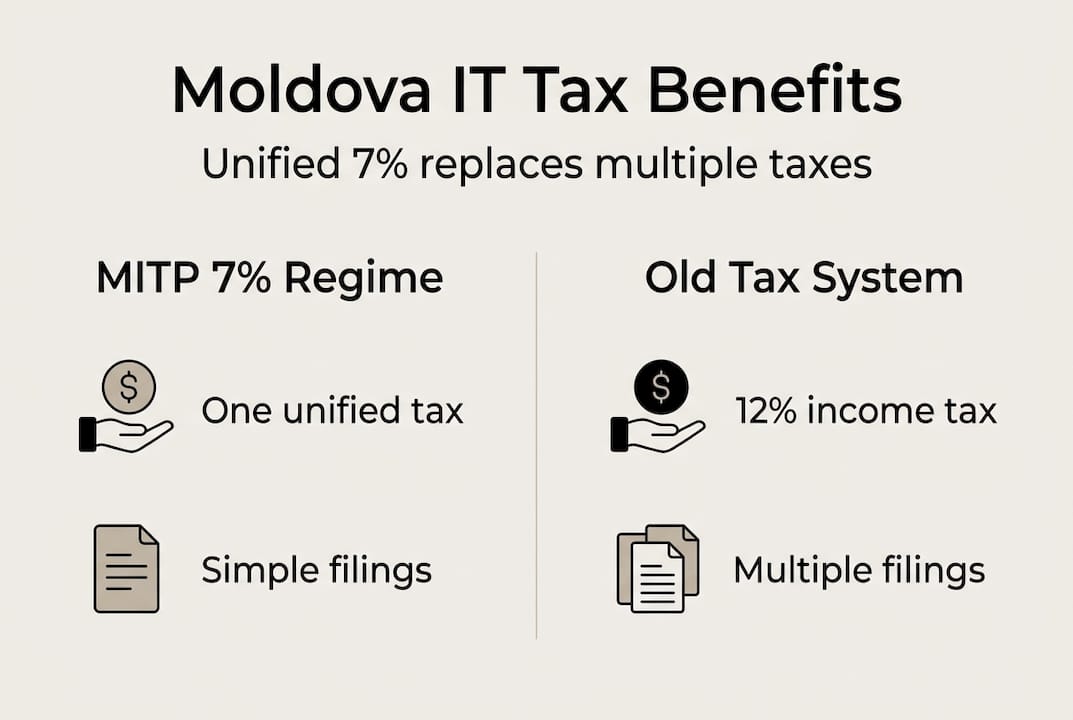
To put that in context, consider the comparison below:
| Jurisdiction | Approximate corporate tax burden | Payroll/social taxes |
|---|---|---|
| Moldova (MITP) | 7% on turnover | Included in unified tax |
| Romania | 16% on profit | ~37% of gross salary |
| Germany | ~30% on profit | ~20% employer contributions |
| Estonia (distributed) | 0% retained, 20% distributed | Standard social tax applies |
The structural simplicity matters as much as the headline rate. Finance teams spend significantly less time managing multiple filing obligations, and the cost of compliance itself falls.
The scale of MITP’s growth tells its own story. The park already counts 2,725 resident companies and 25,809 employees, generating over €665 million in annual turnover in 2023, with projections exceeding €1 billion in 2025 and 88% of that revenue coming from exports. These are not vanity figures. They reflect a functioning ecosystem with genuine export orientation.
Key advantages that draw IT companies to Moldova include:
- Single unified tax covering most fiscal obligations
- Regime guaranteed stable until 2035, offering long-term planning certainty
- Strong export infrastructure with European market access
- Low operational costs relative to Western and Central European hubs
- Straightforward remote setup via Power of Attorney
“Moldova’s MITP is not merely a tax incentive. It is a purpose-built environment for IT companies seeking to operate efficiently at scale while remaining compliant with international standards.”
Understanding why tech companies choose Moldova increasingly means understanding how the MITP regime functions in practice, starting with eligibility.
Eligibility criteria for MITP and tax benefits: what you must know
Accessing the 7% rate is not automatic. MITP has a defined set of entry conditions, and maintaining them continuously is what keeps your company inside the regime.
The core eligibility requirements for MITP are: a Moldovan-registered legal entity, at least 70% of revenue derived from IT activities (with a tolerance of up to two consecutive months below this threshold), at least five full-time Moldovan employees earning at or above the minimum salary threshold, eligible CAEM (activity classification) codes, no insolvency or ongoing litigation, and an annual independent audit confirming continued compliance.
Here is a structured view of the main criteria:
| Criterion | Requirement |
|---|---|
| Legal form | Moldovan SRL (Limited Liability Company) |
| Revenue mix | ≥70% from qualifying IT activities |
| Staff | ≥5 full-time local employees |
| Activity codes | Approved CAEM codes only |
| Audit | Annual independent audit required |
| Financial status | No insolvency or active litigation |
The steps to becoming MITP-eligible are as follows:
- Register a Moldovan SRL with the appropriate CAEM codes
- Apply for MITP residency status
- Hire at least five Moldovan employees on formal contracts
- Establish monthly revenue tracking to confirm IT revenue proportion
- Commission an annual independent audit
- Submit monthly tax filings consistently
The two-month revenue tolerance is worth noting. If your company brings in a consulting project or non-IT income that temporarily pushes IT revenue below 70%, you have a limited buffer. Beyond two consecutive months, you risk losing MITP status and reverting to standard tax rates.
Pro Tip: Build your revenue tracking system before you apply for MITP residency. Knowing your revenue breakdown by activity category in real time makes monthly filings faster and audit preparation far less stressful. This is far simpler to implement at the start than to retrofit later.
For founders exploring this path, the company registration requirements for Moldova are well-defined, and setting up an IT company through a local advisor substantially reduces the risk of missing eligibility steps at the outset.
Why tax filing is central to securing and keeping MITP benefits
Here is the part that many founders underestimate. The 7% tax rate is not a passive entitlement. It is actively maintained through monthly filings that demonstrate your company’s ongoing eligibility.

Each monthly filing serves as a formal declaration of your turnover and revenue composition. These filings are the mechanism by which tax authorities confirm that your IT revenue remains above 70% and that the unified tax applies. Miss a filing, submit incorrect figures, or allow your revenue mix to drift without documentation, and you expose the company to back taxes calculated at standard rates.
Monthly filings prove turnover as the basis for the 7% tax, while annual audits verify the 70% IT revenue eligibility threshold. Together, these two processes allow high-margin IT firms to achieve effective tax rates far below EU norms with genuinely simplified compliance mechanics.
Practical compliance pillars to keep in place:
- Monthly turnover filings submitted on time with accurate revenue categorisation
- Annual independent audit confirming the 70% IT revenue threshold
- Payroll documentation for all local employees, confirming minimum salary compliance
- Activity code alignment ensuring all services billed match approved CAEM codes
- Revenue ledger maintained with sufficient detail for audit sampling
Pro Tip: Treat the annual audit not as a box-ticking exercise but as a genuine quality check. Auditors who flag issues before you submit findings give you the opportunity to remedy gaps. Auditors who sign off on something inaccurate leave the company exposed to regulatory challenge.
The MITP audit process is designed to be workable for lean IT teams. The burden is real but proportionate. Companies that build compliance into their monthly routines rather than scrambling at year-end consistently report lower advisory costs and fewer surprises.
Key stat: MITP residents operating at €1 million turnover pay approximately €70,000 in total tax under the unified regime, compared to €160,000 or more under a comparable EU corporate tax structure when payroll taxes are included.
Practical steps for IT companies: expand to Moldova and manage compliance
Knowing the eligibility criteria and the filing mechanics is useful. Knowing the sequence of actions to take is what makes expansion actually happen.
The practical steps for establishing a compliant, benefits-enabled Moldovan IT company are as follows:
- Register a Moldovan SRL with CAEM codes aligned to your IT service lines
- Apply for MITP residency immediately after registration
- Hire at least five full-time Moldovan employees on documented employment contracts
- Implement a monthly revenue tracking process to monitor your IT revenue percentage
- Engage a local accountant or advisor for monthly tax filings from day one
- Commission your first annual audit at the end of year one
- Review your CAEM code coverage annually as your service offering evolves
Remote setup is entirely possible. Expanding your IT business into Moldova can be handled through Power of Attorney, meaning founders do not need to be physically present for registration. However, substance is non-negotiable.
The MITP regime is confirmed stable until 2035 despite earlier concerns about EU accession obligations. That certainty is genuine, but it comes with the expectation that companies demonstrate real operations: actual employees, genuine IT activities, and documented revenue flows. Anti-abuse provisions are in place and are applied to companies that register in Moldova without meaningful operational presence.
Pro Tip: Keep separate ledger categories for IT and non-IT revenue from the first invoice. Retroactively categorising income under audit pressure is both time-consuming and unconvincing to auditors. Clean records from the start are your strongest asset in any compliance review.
The business incorporation process in Moldova is faster than most founders expect, typically completing within two to three weeks when documentation is in order.
The overlooked importance of substance and vigilance in Moldova’s IT tax regime
Most content about Moldova’s IT tax regime focuses exclusively on the 7% headline rate. That is understandable. It is an exceptional number. But the founders who extract the most value from MITP over the long term are not simply those who register and file. They are those who treat compliance as a strategic function.
The uncomfortable reality is that a meaningful number of companies join MITP with a superficial setup: a registered address, a handful of nominal employees, and revenue categorisation that would not survive a thorough audit. These companies enjoy the rate while the setup holds, but they are accumulating risk rather than value.
Monthly filings and annual audits are not administrative burdens. They are the mechanism that validates your tax position year after year. Companies that treat them as such build a compliance record that withstands scrutiny, including international scrutiny as Moldova moves closer to EU integration.
The regime’s stability until 2035 is good news. But it does not protect companies that have built their tax position on weak substance. Forward-thinking compliance does something else too: it builds credibility with international clients and partners who increasingly ask questions about your tax and legal structure as part of procurement and due diligence processes. A clean MITP record, backed by genuine operations, is a commercial asset. Explore the full tax advantages details to understand exactly what you are protecting.
Next steps: get help forming your IT company in Moldova
If the MITP regime fits your business model, the next move is getting the setup right from the start. At Incorpore.md, we guide IT founders and managers through every stage of the Moldova expansion process, from initial company registration to ongoing monthly filings and annual audit preparation. Use our formation checklist to confirm you have covered every eligibility requirement before you apply. When you are ready to proceed, the step-by-step company registration guide walks you through the full process. For a detailed overview of costs and company registration and tax benefits, our resource pages have everything you need to make an informed decision.
Frequently asked questions
What is the 7% unified tax for Moldovan IT companies?
It is a turnover-based tax for MITP resident IT companies that replaces several conventional corporate taxes, set at a flat 7% rate. The unified 7% tax specifically replaces corporate income tax, payroll taxes, social security, health contributions, property tax, and local taxes.
Can a foreign company access MITP tax benefits without local employees?
No. A Moldovan-registered entity and at least five full-time Moldovan employees are both required to join MITP. The minimum staffing threshold is a firm eligibility condition, not a recommendation.
How often are tax filings submitted under the MITP regime?
MITP resident companies must submit tax returns and related documentation every month. Monthly filings validate the turnover basis for the 7% rate and are central to retaining eligibility.
How long is the Moldovan IT Park regime expected to last?
The MITP tax regime is legally confirmed as stable until at least 2035. This confirmed stability until 2035 provides reliable long-term planning certainty for IT businesses expanding into Moldova.
What happens if a company falls below 70% IT revenue?
MITP allows up to two consecutive months below the 70% IT revenue threshold. Beyond that, the company risks losing MITP benefit eligibility and may face audit scrutiny on prior periods.
Recommended
- Top tax advantages for IT companies in Moldova
- Moldova’s IT Tax Advantage: Why More Tech Companies Are Setting Up Here » Incorpore
- Low Corporate Tax in Europe: Moldova’s 7% Single Tax for IT Businesses » Incorpore
- Tax advantages in Eastern Europe for IT businesses
- Essential tips for EU banking approval in high-risk sectors