

TL;DR:
- Moldova offers fast, affordable remote company registration with full legal recognition for non-residents.
- The Moldova IT Park allows companies to pay a simplified 7% turnover tax, boosting export-oriented IT businesses.
- Successful setup requires genuine local substance and careful planning of banking, documentation, and operational requirements.
Most international founders assume that registering a company in Eastern Europe means mountains of paperwork, mandatory trips to government offices, and months of waiting. Moldova quietly dismantles that assumption. Remote company registration is the process of forming a legal business entity in a jurisdiction without physical presence, using digital platforms, power of attorney, and local representatives. In Moldova, this process is fast, affordable, and fully legal for non-residents. Add a 7% flat tax for IT companies and developer salaries running 40 to 60% below EU averages, and the case for Moldova becomes genuinely compelling.
Table of Contents
- Understanding remote company registration
- The registration process: Steps, requirements, and timeframes
- Tax advantages and the Moldova IT Park
- Practical challenges and common pitfalls
- Our perspective: Who thrives with remote registration in Moldova?
- Next steps: Accelerate your remote registration in Moldova
- Frequently asked questions
Key Takeaways
| Point | Details |
|---|---|
| Remote registration is efficient | Moldova allows remote company formation with minimal bureaucracy and digital procedures. |
| Low costs and favourable taxes | Registration costs are about one-third of EU rates, and IT companies benefit from a unified 7% turnover tax. |
| Strong for IT startups | The Moldova IT Park regime is uniquely suited to export-oriented, high-margin IT firms seeking EU access. |
| Banking and substance hurdles | Non-resident founders must prepare for KYC checks, document translation, and substance requirements to claim tax benefits. |
Understanding remote company registration
Remote company registration means you never need to set foot in Chișinău. No flights booked, no queues at government counters. Instead, your legal representative acts on your behalf through a notarised Power of Attorney, submitting documents and liaising with local authorities while you manage operations from wherever you are in the world.
Moldova makes this straightforward through its Public Services Agency (ASP), which handles company formation digitally. The most common structure for foreign founders is the SRL, which is the Moldovan equivalent of a limited liability company. As confirmed by official investment guidance, non-residents can register an SRL remotely, with 100% foreign ownership permitted, no residency requirement, and minimal share capital ranging from just 1 to 5,400 MDL, roughly €0.05 to €280.
Here is what remote registration in Moldova actually enables:
- Full foreign ownership with no local partner required
- No minimum residency obligation for directors or shareholders
- Digital document submission through authorised representatives
- Legal address services available without a physical office lease
- Power of Attorney accepted for all registration steps
“Remote registration is not a workaround. In Moldova, it is the intended, fully supported pathway for international founders.”
A common misconception is that remote registration creates a shell structure with no legal standing. That is not the case here. Moldova’s framework is built to attract genuine foreign business, and the SRL structure carries full legal rights, including the ability to open bank accounts, sign contracts, and employ staff. You can read a detailed step-by-step company registration guide to see exactly how this unfolds in practice, or explore what starting a business remotely looks like from a founder’s perspective.
The registration process: Steps, requirements, and timeframes
The practical process is more structured than many founders expect, but it is far from burdensome. Here is the standard sequence:
- Pre-registration: Obtain your IDNP (the Moldovan identification number for non-residents). This step is required before any formal submission.
- Choose your entity type: Most international founders opt for an SRL. It offers liability protection and suits both small and scaling businesses.
- Prepare your documents: Identity documents must be apostilled and translated into Romanian by a certified translator.
- Issue a Power of Attorney: This authorises your local representative or legal service to act on your behalf.
- Secure a legal address: A registered address in Moldova is mandatory. Many service providers offer this without requiring a physical lease.
- Submit and pay fees: State fees and professional service fees are paid, and your registration is processed.
As established through the formation process in Moldova, standard registration takes 3 to 5 business days, provided your apostilled documents and translations are ready.
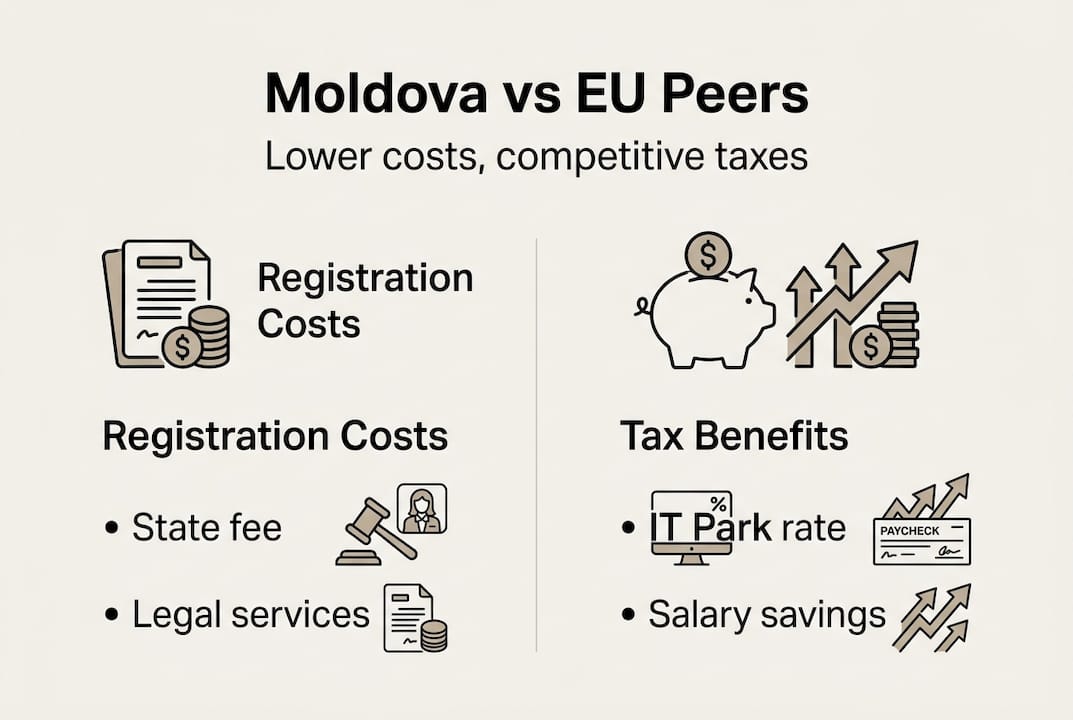
Cost comparison: Moldova vs EU peers
| Cost element | Moldova | Typical EU peer |
|---|---|---|
| State registration fee | €50 to €200 | €200 to €500 |
| Notary, translation, apostille | €50 to €150 | €150 to €400 |
| Legal/professional fees | €200 to €600 | €500 to €1,500 |
| Legal address (per year) | €100 to €300 | €300 to €800 |
| Total estimate | €380 to €1,180 | €1,150 to €3,200 |
As the cost breakdown confirms, total costs in Moldova run at roughly one-third of comparable EU jurisdictions. That is a meaningful saving even before you factor in ongoing tax advantages. Use the registration checklist to ensure nothing is missed, and review the offshore registration steps if your structure involves international holding layers.
Pro Tip: Start your apostille and document translation process before engaging a registration service. These steps sit outside the 3 to 5 day window and can add one to three weeks if left too late.
Tax advantages and the Moldova IT Park
Registering your company is only the beginning. For IT and software businesses, Moldova’s tax regime is where the real advantage lies. The Moldova Innovation Technology Park (MITP) offers a single unified tax of 7% on turnover, which replaces corporate income tax at 12%, payroll taxes, and several other levies. One tax. One rate. Significant simplicity.
To qualify for MITP membership, your company must:
- Be a registered Moldovan legal entity (SRL qualifies)
- Derive at least 70% of revenue from IT activities
- Employ a minimum of 5 staff members
- Conduct genuine operations (no physical office is mandated, but substance is required)
The results speak for themselves. In 2025, MITP resident companies achieved an all-time record with turnover exceeding $1 billion, and the park now hosts 2,725 resident companies supporting 25,809 jobs. Growth is running at 27% year on year, a figure that reflects genuine market confidence rather than promotional optimism.
MITP vs comparable jurisdictions
| Factor | Moldova MITP | Estonia | Cyprus |
|---|---|---|---|
| Effective tax rate | 7% (turnover) | 20% (on distribution) | 12.5% (profit) |
| Developer salary (avg/month) | €800 to €1,200 | €2,500 to €3,500 | €1,800 to €2,800 |
| Remote registration | Yes | Yes | Partial |
| EU member | No (candidate) | Yes | Yes |
As benchmarked in the IT and fintech startup guide, developer salaries in Moldova sit 40 to 60% below EU averages, making it possible to build a high-quality engineering team at a fraction of Western costs. Explore the full picture of IT company tax advantages or get into the specifics of setting up an IT company in Moldova. For a broader comparison, the overview of Eastern Europe tax advantages for IT businesses is worth reviewing as well.

The Moldova IT tax advantage is structured to remain in place until 2035, offering founders a decade of planning certainty that few jurisdictions can match.
Practical challenges and common pitfalls
Even with a favourable setup, founders face specific hurdles worth preparing for. The three most common friction points are banking, substance requirements, and the tax model itself.
Banking is frequently the biggest surprise. Moldovan banks perform thorough KYC checks on non-resident account applicants. You will need a credible business plan, clear source-of-funds documentation, and often local representation to move the process forward. As outlined in the non-resident formation guide, banking hurdles are real and should not be treated as an afterthought. Review what to expect with high-risk or non-resident accounts if your business sector is considered complex.
Substance requirements catch out founders who assume a registered address is enough. To access MITP tax benefits and demonstrate genuine Moldovan operations, you need real activity: employees on payroll, contracts executed, and business decisions made from the entity. A letterbox company will not qualify.
The turnover tax model is excellent for high-margin software businesses, but it can hurt low-margin operations. If your net margins run below 30%, paying 7% on gross revenue may cost more than a standard corporate income tax on profit would. As noted by MITP reporting, the structure strongly favours export-oriented IT firms, not general trading or low-margin service businesses.
Key pitfalls to watch:
- Underestimating apostille and translation lead times
- Failing to secure a compliant IDNP before starting registration
- Assuming banking will resolve itself post-registration
- Overlooking substance requirements for MITP eligibility
- Applying MITP thinking to non-IT or low-margin business models
Pro Tip: Begin your banking preparation at the same time as your registration, not after. Banks move at their own pace, and account activation can take four to eight weeks even when documentation is perfect.
Our perspective: Who thrives with remote registration in Moldova?
After guiding international founders through Moldova’s registration landscape, a clear pattern emerges. The businesses that gain the most are high-margin, export-focused IT and SaaS companies. For them, the combination of a 7% turnover tax, low engineering salaries, and full remote setup is genuinely transformative. It is not a tax trick. It is a well-designed regime that rewards productive IT businesses.
However, we are direct with founders who ask about non-IT or lower-margin models: Moldova is not the right fit for every business. The turnover tax can punish companies with thin margins. And while the MITP framework is stable until 2035, Moldova’s EU candidacy may gradually align its policies with EU tax standards over time. That is worth monitoring.
What many overlook is the substance and banking dimension. The tax savings are real, but they require real operations. Founders who treat Moldova as a purely administrative exercise tend to struggle. Those who commit to building genuine local presence — even a small, remote team — unlock the full benefit. If you are building a scalable IT or fintech business with strong margins and export revenue, Moldova belongs at the top of your shortlist.
Next steps: Accelerate your remote registration in Moldova
If the numbers make sense for your business, the next step is moving from interest to action. Start with the comprehensive company formation checklist to confirm your documentation is in order before engaging any service. If you are setting up an IT company, the dedicated IT company setup guide walks you through MITP eligibility, staffing requirements, and banking considerations specific to your sector. For a full picture of fees, timelines, and tax implications, the detailed process and cost overview covers everything in one place. At Incorpore.md, we handle the entire remote registration process on your behalf, from Power of Attorney to bank account activation, so you can focus on building your business.
Frequently asked questions
How long does remote company registration in Moldova take?
Most remote registrations complete within 3 to 5 business days, though apostille and translation preparation can add additional weeks if not started early.
What documents are needed for remote company registration?
You will need identity proof, apostilled and translated foreign documents, a legal address in Moldova, and a notarised Power of Attorney authorising your local representative.
Who is eligible for Moldova IT Park tax benefits?
Eligibility requires a Moldovan-registered entity, at least 70% IT revenue from qualifying activities, a minimum of 5 employees, and demonstrated operational substance.
Are there banking challenges for non-residents registering remotely?
Yes. Banks require thorough KYC checks, a credible business plan, and source-of-funds documentation. Banking for non-residents can take four to eight weeks and should be prepared in parallel with registration.
Is remote company registration cost-effective compared to Estonia or Cyprus?
Moldova’s total registration costs of €380 to €1,180 are roughly one-third of comparable EU jurisdictions, with lower ongoing tax rates and significantly lower talent costs than either Estonia or Cyprus.